Tuesday, September 28, 2010

A Cross-Cultural Experience

Day 71: Wednesday, September 15, 2010
The Great Smoky Mountains; Cherokee village Oconaluftee in NC
We drove off that morning to Cherokee, North Carolina to visit an authentic Cherokee village, Oconaluftee. Auntie Cindy kept raving, "Oooo! It'll be a cross-cultural experience!" Yippee.I loved it. The Cherokee are an absolutely fascinating tribe--inconceivably advanced in so many ways. We walked by several dwellings in which villagers were working at a particular craft: necklace and sash-beading, pottery-molding, arrowhead-making, finger-weaving, basket-making. The woman basket-weaving is currently featured in the Smithsonian for her art. What a treat!Soon we were called to gather in the central part of village for a social dance celebration. It was really interesting to observe the differences between the Oglala Lakota or the Midwestern Native Americans (primarily Sioux) and the Cherokee.People have several misconceptions about Native Americans, obviously. They expect to see feathers and teepees, and hear howling and whooping. The Cherokee, however, rarely used feathers in dancing; feathers were reserved for specific ceremonies, most of which are too sacred to preform for outsiders. They never used teepees; they were far too advanced for that. The Cherokee created sturdy, square houses from adobe, straw, logs, and natural formations, like banks.
The Cherokee have a very specific structure. Each tribe consists of seven universal clans: the Wild Potato Clan, the Wolf Clan, the Deer Clan, the Blue Man Clan, the Paint Clan, the Long-Haired Clan, and the Wolf Clan. Each clan is associated with certain qualities and responsibilities. The Cherokee are a matrilineal society; all property belongs to the woman of the house. In fact, the Cherokee offered their women incredible freedom, even allowing them to fight alongside the men in battle, and allowing the Elders to weigh in on Council decisions.

I could go on and on, but I am pressed for time; I will finish if given more time.

After our enjoyable time at the village, we were recommended to sup at Paul's Restaurant for some Cherokee food. It was glorious.

What's So Special About the Smokies?

Day 70: Tuesday, September 14, 2010
The Great Smoky Mountains
Even as the previous night had disillusioned me, the beauty of the Great Smoky Mountains immediately set to work at appeasing me the following morning.

The owner of the campground we were staying at was an intelligent, sharp, sweet, inspiring woman with a deep respect for the outdoors and her fellow travelers. She shared with me an incredible passion for exploring this world we have been given, and had an uncanny way of looking me straight in the eyes and remarking, "Most people out there...They will never see what you have seen. You have been given an opportunity. It changes you."How could a woman I had just met, a woman from Michigan, by way of Tennessee, know exactly how I was feeling?Taking her advice, we headed off to the Sugarlands Visitor Center in the park. There I was surprised to learn that due to the Last Ice Age, the area encompassed by the Great Smokies changed to support very different types of wildlife, in addition to the ones already there, as species migrated southward. The drastic changes in elevation already present offer a large range of climates, comparable to a trip from Tennessee to Canada, the tour guides like to boast.

The variety of altitudes, the incredible rainfall, and the few unlogged portions of old-forest growth help the Smokies to support well over 10,000 species of plants and animals, many of them not found anywhere else on Earth, such as the Jordan's Red-Cheeked Salamander. New species are still being discovered in the park today by biologists and college students.Newly enlightened with an appreciation for the park in which we were driving, we set off to hike to Laurel Falls that afternoon. Although the hike was relatively short, the sheer variety of vegetation in the canopy and ground cover from elevation to elevation was not only noticeable, but fascinating. One side of a ravine might have tall leafy trees and limited ground cover and cool, and around the corner could be predominantly small bushes and much warmer.Along the hike we were hailed by a couple who recognized us from Mammoth Cave, much to our surprise. We chatted and they were stunned upon hearing the breadth of our journey. Glad to know we made an impression back in Kentucky, I guess.Laurel Falls was worth it. Although her flow was relatively small, given the dryness of the current season, she splashed merrily over the rocks and into a river down below us, feeding and nourishing the surrounding vegetation and wildlife.At one point, Auntie Cindy thought she heard a bear close by and tried telling us to run ahead out of danger. Matthew and I ignored her, arguing the three of us would have a better chance of scaring away a startled bear. A battle of bear facts followed. Thankfully, the rustling appeared to be the work of clever squirrels.

Escape from the Tourist Trap

Day 69: Monday, September 13, 2010

Drive from Kentucky to Tennessee

We had had fun in Kentucky, but we had to be pressing on. The drive from Kentucky into Tennessee was glorious. I tried to steal the dog pictured above. Although we did not get to see the full extent of the fields of rolling bluegrass in the Bluegrass State, we did notice the change into the rockier greener country of the Volunteer State.

Matthew had been watching the National Parks of America DVDs and consequently was greatly excited by the Great Smoky Mountains; I was less enthused. Part of me even dreaded the stop. We fear the unknown.

Not knowing anything about the area, we drove through Pigeon Forge and Gatlinburg en route to a hopefully quiet and dark campground for the night. Now, I have been to Las Vegas (I have a hazy recollection of waiting outside a casino for hours as my grandmother gambled away my uncle's earnings), but these two towns were absolutely horrifying and, in my opinion, even worse. There were flashing lights, huge signs, gigantic amusement parks and tourist attractions up and down both sides of the highway. There was a huge replica of the Titanic at dock. There were dozens of roller coasters. Endless streams of shops. Inns, hotels, pools, dinner theaters. It was beyond garish. It was beyond depressing. It was vomit-inducing.

The sight just filled me up with sadness. Here in Tennessee lies an entire community, whose sole source of income is pandering to hapless, witless tourists that bumble through. It was every possible material item or experience you could want--and I wanted none of it. I wanted out.

Needless to say, the traffic was terrible, as only about ten percent of the drivers were even watching the road, so overwhelming were the neon lights.

There was even something horrifying called Dollywood, an amusement park dedicated to Dolly Parton, the blondest and bustiest of the busty blonds. Every night was a marathon performance by no less than seven Elvis impersonators in a hotel lounge. In my mind the most horrid was the commercial tourist attraction "JesusTown", or something to that effect, featuring life-size figures with creepy unfeeling faces. It gave sacrilegious a different meaning.

I was nothing short of relieved to make it through Pigeon Force and Gatlinburg with my brain intact. My faith in humanity, however, was ebbing.


About Twelve Dollars!

Day 68: Sunday, September 12, 2010

Mammoth Cave National Park

That night it was actually hard to sleep because of the excessive mooing of the herd of cows dusting the fields and hills bordering the campsite. Consequently, I was attacked by a serious fit of the giggles. Who knew cows were this social after dark? But they were gone in the morning and we never saw them again.

The next day was devoted to exploring Mammoth Cave National Park, the largest and longest underground cave system in the world, and, sadly, pretty much the only reason tourists stop in Kentucky.

After my experience at Wind Cave, I was extremely excited for Mammoth Cave. I had already ascertained that I was enough of a wacko to adore spelunking—the combination of adventure, geology, and earth science apparently really interest me.

Upon entering the Visitor Center, we migrated over to a small podium under a prominent white banner bearing the slogan: Eliminate White Nose Syndrome! I thought it was some sort of creative racial slur. It turns out that White Nose Syndrome is a condition that is wreaking havoc upon the bat populations across the United States—from New England down to the South, and as far west as Oklahoma. Upon entering a cave, the fungus dusts the noses of the bats, turning them white. The fungus then grows and irritates the bats to the point that they wake up from hibernation, upsetting their natural cycle, and driving them out of the cave in the dead of winter to hunt for nonexistent food. When hunting and

foraging prove unfruitful, they die from malnourishment. While in most cases, the fungus spreads from bat to bat, other animals (including humans) are responsible for its continued spread across the nation.

The frightening thing is that the fungus spores can live for up to five years by themselves! So if you have been in a cave in the last five years, the Park Rangers ask to decontaminate any items you may have worn during the previous visit. For us that meant our shoes and camera. I'm sure it must have been somewhat frightening to the other tourists, the three of us taking off our shoes and dunking them and letting them sit in tubs of disinfectant.

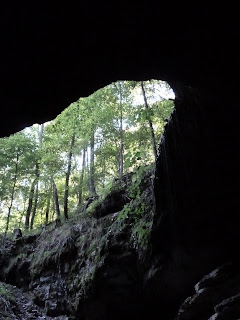
Our tour group was definitely over 100 people—substantially larger than the previous tour. We were bused over to the large sinkhole in which was the original entrance to Mammoth Cave. Today the cave system is known to include over 367 miles of passageway—over twice the length of the second longest, Jewel Cave in South Dakota.

Much of the cave system is covered by a sandstone capstone, which has dissolved in parts over the years due to continued water seepage. As these cracks widen and deepen, the acidity from the groundwater erodes the sandstone, and eats into the limestone layers beneath. The Green River is the main river responsible for much of the Mammoth Cave system. As the river level sinks, the groundwater table rushes downwards as well, dissolving rock along the way and forming extensive cave passages at varying depths.

According to our tour guide, there are three distinct (somewhat ominous-sounding) sections in Mammoth Cave: living cave, dormant cave, and dying cave. Living cave is identified by the presence of water. At the entrance of the cave are vertical shafts and narrow staircases that lead further and further down underground, dampness and puddles exacerbating the journey. At one point I reached out my hand blindly forward, groping for the wall, and instead flinched as I came into contact with the slimy, grimy cave wall. From then on, of course, I purposely grabbed the wall. The presence of moisture means there are different colored algae and fungi and some small cave-dwelling creatures, several of which are both endangered and eyeless, like the Kentucky cave shrimp.


Dormant cave is distinguished by enormous caverns large enough to fit our entire group comfortably. These 'rooms' are the result of layers of limestone that have buckled under the pressure of the ceiling above it. As each layer crumbles, it supports the layer above it, allowing the ceiling to extend a bit further, and leaves chunks of rock the size of cars laying strewn about. In one such 'room', Edwin Booth recited Hamlet to a lucky tour group (hopefully not in its entirety).


Dying cave is the oldest part of the cave, as its name suggests. The most famous feature at this end is the Frozen Niagara, an impressive display of the beauty in dripping limestone.

At one point, the tour guide called out, "Who can tell me the difference between this part of the cave and the cave at the entrance?" A hillbilly old man drawled out, "About twelve dollars!" Under those overalls, he was sharp. The tour guides chuckled and asked if they could use that in their following tours. "We're always looking for more material!"

Following our time in the cave, we hiked through the Park to the Main Entrance, past where the River Styx flows through the cave, up to Sunset Point. We were quite surprised to find Asian bamboo in the woods.
As we started to walk back to the now-deserted parking lot, we ran into the midst of a group of deer, bounding across the lawn to graze. There were a few fawns in tow and it was amazing seeing those thin, furry legs prancing around happily.


Kentucky was a good time.


Sunday, September 26, 2010

The Double-Crosser Has Been Double-Crossed

Day 67: Saturday, September 11, 2010

Indy 500; Trader Joe's; Double-crossing

KOA in Horse Cave, KY

The day began with a toad.

As you all may or may not know, I am a race-car fanatic. Clearly. So I was wildly excited to visit the Indy 500—the largest single-day sports event in the world. On this day my yearning ceased as my deepest desire was realized.

But in all sincerity, the Indy 500 racecourse is pretty awe-inspiring. It wraps completely around a museum, parking lot, several fields, and sections of bleachers for the thousands of spectators. The Indy 500 is currently celebrating its Centennial Era, as its first race was in 1911. Back then, the winning speed was in the 70s; today it is about 226 miles per hour. The difference in time separating a winner from a runner-up? Under half a second. Incredible.

Although we did not see a race while we were in Indianapolis, we did notice a group of three or four white pick-up trucks that were racing around the track at a leisurely pace. They looked like they were having so much fun.

We did not see much of Indianapolis during our drive through the city. It was larger than I was expecting. Lots of large hotels. Lots of construction. Huge sports arenas for teams I do not care about. Once a Boston fan, always a Boston fan.

Before leaving the capitol, however, we popped into Trader Joe's for some much-needed re-stocking of our staples. There I discovered chocolate-covered pistachios, to my utter delight. I called my friend Hannah on the spot to gush. Then, quite suddenly, my best friend turned against me, chatting on the phone to Auntie Cindy, and then reprimanding me for not making enough headway on my college essays! The nerve. The audacity. The treachery.

I also encountered the following, causing Matthew to collapse into malicious laughter: (Kenny, avert your eyes!)

And then I drove the lot of us into Kentucky, belting and belching all the while!

Friday, September 24, 2010

Proof that I May Still Be a Child...Despite What the State of California Thinks!

Day 66: Friday, September 10, 2010
The Children's Museum in Indianapolis

At long last we made it to the reason we came to Indiana in the first place: The Children's Museum of Indianapolis. Although I had heard it was the largest children's museum in the world, I was not enthused. I know I am a good 99% nerd, but showing excitement for a children's museum seemed too embarrassing. I was more fascinated with the stunning architecture of the facades a couple blocks away.But when we rounded that corner to approach the Museum, Matthew and I screamed: him with delight, me with shock. There were dinosaurs breaking out the building up ahead! And more dinosaurs streaming in through the glass entrance! That was the moment we knew we would enjoy our experience.

First of all, it was enormous. Absolutely enormous. We were so thankful that we were visiting on a weekday because the elaborate system of lines suggested they expected quite a few visitors. The first exhibit that we were drawn into was entitled Dinosphere: Now You're in THEIR World.

Rounding a corner, we entered a large dome, where the lights went dark blue and we were inundated with sounds of another world. Giant dinosaurs dwarfed us, carefully arranged in realistic scenarios, forcing the visitors to unlock the dynamics of a time gone by. For instance, one dinosaur was shown devouring another one, begging the question of whether the consumer was a hunter or mere scavenger. Well, paleontologists, in examining the skeletons, ascertained that the consumer was a scavenger, owing to the multitude of broken bones and injuries she had sustained. She even had a brain tumor!

The exhibit was colorful, interactive, educational, and incredibly kid-friendly. There was even a section where we could observe actual paleontologists at work and question them about their work.

The other exhibits we enjoyed were Fireworks of Glass, Carousel Wishes and Dreams, ScienceWorks, the Biotech Learning Center, All Aboard!, and Take Me There: Egypt.

We were awed by a tower of glass sculptures, a large water system in which to build and race boats, a musical system of pool balls, and pictures and videos depicting life in Egypt. We even learned a few words of Arabic.

Perhaps my favorite part was the water clock that dominates the main floor. I could have stood for hours, gazing up at that tower, remarking at the bobbing pieces, the altering water pressure--the physical manifestation of time, constantly in flux.

As one final addendum, one of the exhibits was dedicated to Barbie. The Gift Shop prominently featured the most frightening and disgusting thing I have ever seen. I could not get out of there fast enough.